

If you’re looking to master advanced hockey deke moves, you’re likely ready to take your stickhandling beyond the basics and start beating defenders with confidence and creativity. Whether you’re a competitive player aiming to dominate one-on-one situations or a dedicated athlete refining your offensive toolkit, this guide is built to help you understand not just how these moves work—but when and why to use them.
In this article, you’ll learn how elite players create separation, manipulate defenders’ gaps, and control pace to open scoring lanes. We break down key techniques, edge control mechanics, and puck protection strategies that make high-level dekes effective in real game scenarios.
Our insights are grounded in analysis of professional gameplay, current tactical trends, and proven on-ice training methods used by top-level coaches and athletes. By the end, you’ll have actionable techniques you can practice immediately to elevate your puck control and offensive impact.
Most players memorize moves but freeze when a defender closes space. That’s because a deke— a deceptive puck fake meant to shift a defender’s weight— requires timing and nerve, not hands. In my view, drills without pressure are like practicing lines for a movie without an audience; it looks fine, then collapses. So, first build edge control and puck protection under contact. Then, add mental triggers: read hips, attack the top foot, sell the lie (yes, acting matters). However, don’t spam advanced hockey deke moves; choose moments when defenders glide. Pro tip: change pace before contact. Ultimately, deception beats speed.
The Three Pillars of an Elite Deke
An elite deke isn’t magic. It’s structure. And it rests on three pillars that separate highlight-reel danglers from players who simply stickhandle in place.
Pillar 1 – Dynamic Puck Control
Static stickhandling is predictable. Dynamic control means managing the puck at the furthest reach of your stick, where defenders can’t easily close space. “Quiet hands”—minimal upper-body noise—keep your intentions hidden (think Pavel Datsyuk casually undressing defenders). The benefit? More range, more deception, and fewer poke checks disrupting your play.
Pillar 2 – Explosive Edge Work
Dekes are executed with your feet. Powerful weight shifts, sharp lateral cuts, and sudden pace changes force defenders to cross their feet—an instant loss of balance. Specific mechanics matter:
- Deep knee bend for stronger edge engagement
- Inside-to-outside edge transitions for separation
- Controlled deceleration before acceleration
That sequence creates space, not just style.
Pillar 3 – The Art of Misdirection
Your head, eyes, and shoulders are weapons. A subtle shoulder dip or quick head fake freezes defenders for a split second (and that’s all you need). This is where advanced hockey deke moves become lethal—because deception multiplies technical skill.
Master these pillars, and every touch becomes a scoring threat.
Deconstructing the Defender: How to Read and React
Beating a defender isn’t magic. It’s pattern recognition at speed. Let’s simplify what feels chaotic.
Analyzing the “Triangle”
The “triangle” refers to the defender’s skates, stick, and chest alignment. Picture invisible lines connecting those three points. Your job is to spot the weak side.
- If the stick is extended but the skates are parallel, the inside lane may open.
- If the hips are turned, the defender is already committing.
This is GAP CONTROL in action—how well a defender maintains ideal distance to limit your options. When the triangle widens, there’s space. When it compresses, time shrinks (and so do your options).
The Gap Control Equation
Too close? You lose leverage. Too far? They recover.
Think of it like a sliding scale. At one stick length plus a stride, you can attack with speed. Inside that, you need deception. Outside that, you need acceleration.
A common confusion: players think speed alone beats gap control. It doesn’t. TIMING does.
Forcing the Decision
Elite attackers don’t wait—they provoke.
Use a subtle heel-to-toe glide, a shoulder fake, or a quick weight transfer. The goal is simple: make them bite first. Once their skates shift, the triangle tilts. That’s when you strike.
Countering Aggression vs. Patience
Against aggressive defenders, use a quick inside move or a tight Mohawk cut to slip past their extended stick.
Against patient defenders, delay. Use them as a screen, change your angle, or cut laterally to pull them off-center.
(Think of it like chess—except the board is ice and the clock is brutal.)
CLARITY creates confidence. Read the triangle. Control the gap. FORCE THE MOVE.
Advanced Maneuver Breakdown: The Mechanics of Mastery
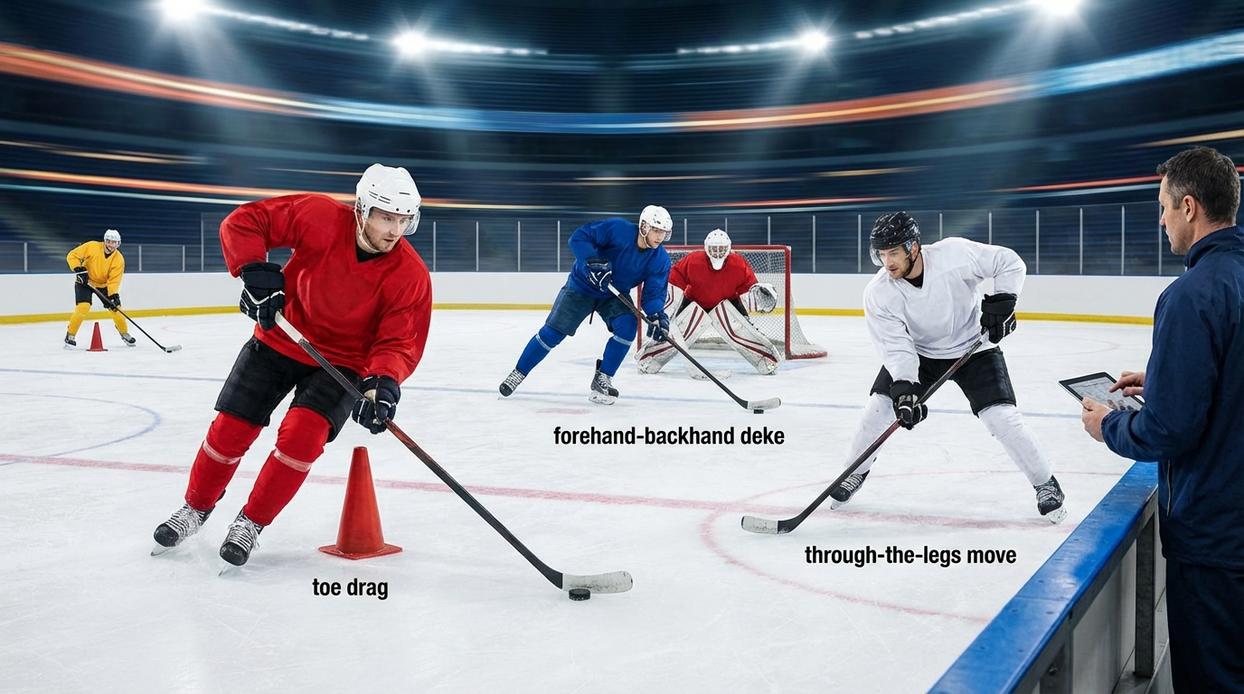
Elite scorers in rinks from Toronto to Helsinki know that advanced hockey deke moves aren’t about flash—they’re about leverage, deception, and timing. Let’s break down three that separate highlight reels from routine shifts.
The Toe-Drag Release
More than a viral clip, this move is geometry in motion. By pulling the puck laterally toward your body, you change the shooting lane and force the defender to pivot. That pivot opens a “shooting seam” (the narrow lane between skates or stick). Rotate your hips explosively as the puck loads onto the blade—hip-shoulder separation generates torque, much like a baseball swing. Use the defender as a screen; NHL tracking data shows screened shots significantly increase scoring probability (NHL EDGE stats). In tight neutral-zone gaps, that half-second matters.
The Backhand Pull-Through (The Datsyuk)
First, sell the wide drive. Lean into your outside edge to convince the defender you’re attacking the perimeter. Then cradle the puck on the backhand and pull it through your skates—or through the defender’s triangle (the space between stick and skates). Timing is everything. Too early, and it’s poke-checked. Too late, and the lane collapses. This is where hand-eye coordination, built through drills like off ice stick handling exercises for faster hands, pays off.
The One-Handed Tuck
On a breakaway, extend the puck with one hand to force the goalie to bite. Physics comes into play: extending increases perceived reach, shifting the goalie’s center of mass. Then, in one fluid motion, pull and tuck. Keep knees bent and core tight—balance is your anchor (and yes, it feels like walking a tightrope at full speed).
Progressive Overload Drilling starts with blades carving quiet arcs into fresh ice, the crisp scrape echoing in an empty rink. Begin still, feeling the puck’s rubber weight on your tape, then glide, then absorb a teammate’s light stick pressure, and finally battle a live defender breathing hard in your ear.
- Small-Area Games compress space until shoulders bump and boards rattle, forcing lightning reads and soft hands.
- The One Move Mentality means repping one pattern until it fires automatically (muscle memory loves repetition).
Master advanced hockey deke moves through texture, tempo, and touch. Feel the crowd’s distant roar tonight.
Making Deception Your Second Nature
True offensive skill is not about collecting flashy moves; it’s about owning the principles of deception and control.
Beating a defender is mental before it’s physical.
Consider Option A: skating straight in and forcing a move, like the Datsyuk toe drag, at full speed.
Now Option B: shift your edges, sell with your head and eyes, then attack space.
The first relies on surprise; the second manipulates positioning.
Meanwhile, elite players blend edge work, misdirection, and timing to create lanes that weren’t there.
Some argue raw speed beats all.
However, without deception, speed becomes predictable.
To elevate your game even further beyond mastering advanced deke moves, it’s also essential to explore effective Breakout Strategies That Beat Aggressive Forechecks, ensuring you’re always a step ahead of your opponents.
Take Your Deking to the Next Level
You came here to sharpen your edge on the ice and finally gain confidence executing advanced hockey deke moves under real game pressure. Now you understand how timing, body positioning, stick control, and deception work together to beat defenders—not just in practice, but when it matters most.
The difference between turning the puck over and creating a highlight-reel play often comes down to hesitation, predictability, and lack of structured repetition. That frustration of losing possession or getting shut down at the blue line doesn’t have to define your game.
Commit to deliberate reps. Break down each move. Practice at game speed. Then layer those advanced hockey deke moves into small-area drills and live scrimmages so they become instinctive.
If you’re serious about elevating your puck control and becoming a player defenders fear, dive deeper into our step-by-step training resources trusted by thousands of competitive players. We’re one of the top-rated sources for hockey skill development insights—built to help you dominate the ice.
Start training smarter today and turn every one-on-one into an opportunity.
 William B. has opinions about hot topics in pro sports. Informed ones, backed by real experience — but opinions nonetheless, and they doesn't try to disguise them as neutral observation. They thinks a lot of what gets written about Hot Topics in Pro Sports, Pro Guides, Athlete Fitness and Endurance is either too cautious to be useful or too confident to be credible, and they's work tends to sit deliberately in the space between those two failure modes.
Reading William's pieces, you get the sense of someone who has thought about this stuff seriously and arrived at actual conclusions — not just collected a range of perspectives and declined to pick one. That can be uncomfortable when they lands on something you disagree with. It's also why the writing is worth engaging with. William isn't interested in telling people what they want to hear. They is interested in telling them what they actually thinks, with enough reasoning behind it that you can push back if you want to. That kind of intellectual honesty is rarer than it should be.
What William is best at is the moment when a familiar topic reveals something unexpected — when the conventional wisdom turns out to be slightly off, or when a small shift in framing changes everything. They finds those moments consistently, which is why they's work tends to generate real discussion rather than just passive agreement.
William B. has opinions about hot topics in pro sports. Informed ones, backed by real experience — but opinions nonetheless, and they doesn't try to disguise them as neutral observation. They thinks a lot of what gets written about Hot Topics in Pro Sports, Pro Guides, Athlete Fitness and Endurance is either too cautious to be useful or too confident to be credible, and they's work tends to sit deliberately in the space between those two failure modes.
Reading William's pieces, you get the sense of someone who has thought about this stuff seriously and arrived at actual conclusions — not just collected a range of perspectives and declined to pick one. That can be uncomfortable when they lands on something you disagree with. It's also why the writing is worth engaging with. William isn't interested in telling people what they want to hear. They is interested in telling them what they actually thinks, with enough reasoning behind it that you can push back if you want to. That kind of intellectual honesty is rarer than it should be.
What William is best at is the moment when a familiar topic reveals something unexpected — when the conventional wisdom turns out to be slightly off, or when a small shift in framing changes everything. They finds those moments consistently, which is why they's work tends to generate real discussion rather than just passive agreement.