

If you’re looking to sharpen your edge on the ice, refine your tactics, and elevate your overall performance, you’re in the right place. This article is designed to break down the essential elements of modern hockey—from evolving pro-level strategies and advanced stick handling mastery to athlete conditioning and smarter game day preparation. Whether you’re a competitive player or a dedicated fan of the sport, you’ll find practical, experience-backed insights that translate directly to real performance improvements.
We draw on in-depth analysis of pro sports trends, proven training methodologies, and performance data used across competitive levels of hockey. That means you’re not getting recycled advice—you’re getting structured, actionable guidance grounded in how the game is actually played today.
You’ll also learn how to strengthen hand-eye coordination for hockey, improve decision-making under pressure, and build habits that carry over into every shift. Let’s break down what truly makes the difference between good and game-ready.
Unlocking Your On-Ice Potential
By honing your hand-eye coordination through targeted drills, you’ll not only elevate your stick skills but also enhance your overall performance, preparing you to implement the strategies discussed in our article, ‘The Ultimate Game Day Routine for Peak Performance.’
For years, players believed repetition alone built greatness. Yet by midseason—after three months of grinding the same drills—many hit a wall. The issue isn’t effort; it’s structure. True motor learning (the brain’s process of automating movement) demands targeted refinement of skating mechanics, stickhandling control, and shooting release timing. Some argue natural talent eventually takes over. However, research on skill acquisition shows deliberate, feedback-driven practice accelerates mastery (Ericsson, 1993). Start with edge-control skating patterns, layer in hand-eye coordination for hockey, then progress to variable shooting reps. Over time, movements shift from conscious thought to instinct—where elite performance lives.
The Blueprint for Skill: How Your Body Learns Hockey
Gross motor skills are large, powerful movements—like your skating stride or a slap shot. Fine motor skills are smaller, precise actions—like cradling a pass or adjusting blade angle mid-play. Both matter, but they require different training approaches. You can’t refine hand-eye coordination for hockey by only skating suicides (no matter how tough that makes you).
Some argue repetition alone builds mastery. Not quite. The real driver is myelination—the process where repeated, correct movements strengthen neural pathways, making actions automatic and faster (think muscle memory, but neurological) (Fields, 2008, Scientific American).
To improve efficiently, use deliberate practice—training at the edge of your ability and correcting mistakes immediately (Ericsson, 1993).
- Practice skating strides at 90% speed, focusing on knee bend and full extension
- Run tight stickhandling drills while keeping your head up
- Film 10 reps, review, adjust, repeat
Pro tip: Short, focused sessions beat mindless marathon practices.
Mastering Your Edges: The Foundation of All Movement
Why Edges Matter Most
First things first: your edges are the foundation of everything you do on the ice. Edges refer to the inside and outside steel lines of your skate blade that grip the ice and generate force. Every burst of speed, sharp turn, and quick stop begins there.
Some coaches argue that strength training or stick skills should take priority. That’s fair—hockey is multifaceted. Still, without precise edge control, that power has nowhere to go. It’s like putting a race car engine in a vehicle with bald tires (impressive, but not effective). I’ll admit, it’s hard to measure edge mastery with clean stats, but watch elite skaters closely—their control is unmistakable.
Drill Focus – Inside/Outside Edge Control
To build that control, start with single-leg figure-eights. Glide on one foot, tracing a wide eight pattern while alternating inside and outside edges. Then progress to tight-radius circles, gradually shrinking the turn to challenge ankle stability and balance. These drills strengthen stabilizer muscles and improve proprioception (your body’s awareness in space).
Drill Focus – Explosiveness and Deception
Next, layer in explosiveness. Practice powerful C-cuts—short, forceful pushes using the inside edge—to accelerate from a standstill. Add crossover starts for lateral power, then sharp stop/start sequences to simulate evasion. Defenders react to predictable patterns; sharp edge transitions create deception.
Integrating the Puck
Finally, run edge drills with a puck. Blending lower-body mechanics with upper-body control develops hand-eye coordination for hockey and real-game fluency. For deeper progression, explore stick handling drills to improve puck control under pressure. After all, edges win space—but puck control wins plays.
Making the Puck an Extension of Your Stick
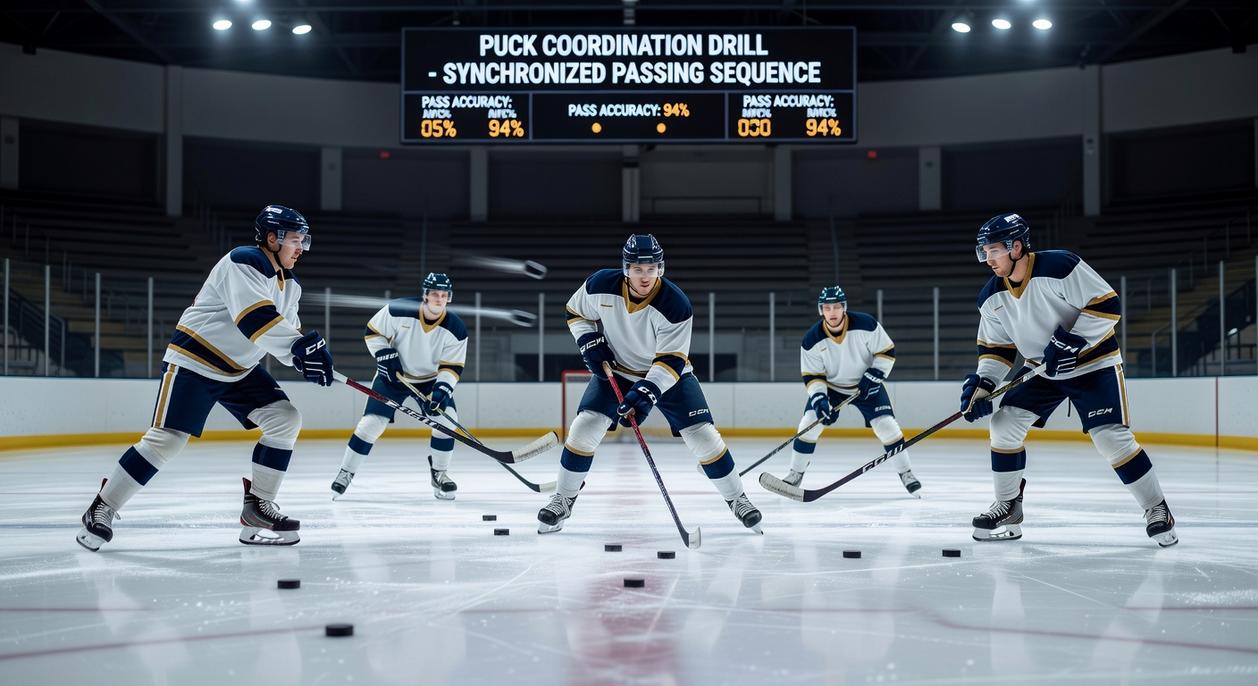
Great stickhandlers don’t control the puck—they absorb it. Developing “soft hands” means receiving passes with relaxed wrists and slightly cushioned arms so the puck settles instead of ricocheting. Think of it like catching an egg instead of clapping at it (unless you enjoy cleaning yolk off the ice). Soft hands reduce noise in your movements and buy you milliseconds—precious time in tight spaces.
Some coaches argue tension equals strength. But watch elite players: their top hand guides, the bottom hand stabilizes, and neither chokes the stick. The puck stays quiet. That quiet control is the edge most training programs overlook.
Off-Ice Dexterity That Transfers
Daily work with a stickhandling ball or even a golf ball sharpens touch faster than ice time alone. The smaller, livelier surface exaggerates mistakes and accelerates adaptation. Focus on:
- Keeping your head up
- Quick toe drags and pull-drags
- Alternating narrow and wide dribbles
This directly improves hand-eye coordination for hockey while reinforcing spatial awareness. Pro tip: practice in low light occasionally; it heightens feel through the blade.
On-Ice Control Under Pressure
Start stationary: wide lateral dribbles, heel-to-toe rolls, and controlled pull-backs. Then layer movement—figure-eight cone weaves, speed bursts between touches, and reactive drills where a partner applies light stick pressure. Progressively increase pace, not panic.
The “head up” imperative separates performers from pretenders. Try stickhandling while staring at the boards or calling out numbers a teammate flashes. When vision is occupied, your hands learn to think independently. That’s when the puck truly becomes an extension of your stick.
Refining Your Shot: From Power to Precision
Power doesn’t start in your arms—it starts in your core. Think of your body like a coiled spring: when you load your hips, engage your abs, and transfer weight from back skate to front, that stored energy releases through the stick. Many players argue upper-body strength is the key. However, without sequencing from the ground up, you’re just muscling the puck (and sacrificing consistency).
Next, sharpen speed with a quick-release progression:
- Catch and fire: Receive a pass and shoot in one motion—no stickhandling.
- Angle variation: Repeat from both circles and the high slot.
- Pressure timing: Add a defender closing in.
Meanwhile, accuracy separates scorers from shooters. Divide the net into small zones and aim for specific corners repeatedly from different distances. This not only builds precision but also reinforces hand-eye coordination for hockey under realistic pace. Competitors rarely emphasize measurable zone tracking—chart your hits to identify true scoring patterns.
Integrating Skills for Game-Day Dominance
Mastery is built on intentional practice of foundational motor skills—edges, hands, and mechanics. More ice time alone will not make you dominant; smarter ice time will. Choose drills that sharpen timing, balance, and hand-eye coordination for hockey under pressure. If you want results, commit to ten focused minutes on one drill next session. Track repetitions, demand game-speed intensity, and finish every rep with purpose (yes, even when you’re tired). Pro tip: film one set to spot mechanical leaks. Consistency compounds; small upgrades today become big plays tomorrow. Win with disciplined daily execution. On every shift.
Take Your Game to the Next Level
You came here looking for clarity on how to sharpen your edge on the ice—and now you have a practical roadmap to elevate your performance. From refining your positioning to improving puck control and developing elite hand-eye coordination for hockey, you understand what it takes to compete with confidence and consistency.
The truth is, most players struggle not because they lack effort, but because they lack focused, game-ready preparation. Missed passes, slow reactions, and inconsistent stick handling can cost you critical moments. The difference-maker is committing to targeted skill development and smarter training habits.
Now it’s time to act. Start integrating these drills into your weekly routine, track your progress, and push yourself in game-like scenarios. If you’re serious about dominating the ice, get access to proven training insights and performance strategies trusted by dedicated players who refuse to settle for average. Don’t wait for game day to expose weaknesses—start building your competitive edge today.
 William B. has opinions about hot topics in pro sports. Informed ones, backed by real experience — but opinions nonetheless, and they doesn't try to disguise them as neutral observation. They thinks a lot of what gets written about Hot Topics in Pro Sports, Pro Guides, Athlete Fitness and Endurance is either too cautious to be useful or too confident to be credible, and they's work tends to sit deliberately in the space between those two failure modes.
Reading William's pieces, you get the sense of someone who has thought about this stuff seriously and arrived at actual conclusions — not just collected a range of perspectives and declined to pick one. That can be uncomfortable when they lands on something you disagree with. It's also why the writing is worth engaging with. William isn't interested in telling people what they want to hear. They is interested in telling them what they actually thinks, with enough reasoning behind it that you can push back if you want to. That kind of intellectual honesty is rarer than it should be.
What William is best at is the moment when a familiar topic reveals something unexpected — when the conventional wisdom turns out to be slightly off, or when a small shift in framing changes everything. They finds those moments consistently, which is why they's work tends to generate real discussion rather than just passive agreement.
William B. has opinions about hot topics in pro sports. Informed ones, backed by real experience — but opinions nonetheless, and they doesn't try to disguise them as neutral observation. They thinks a lot of what gets written about Hot Topics in Pro Sports, Pro Guides, Athlete Fitness and Endurance is either too cautious to be useful or too confident to be credible, and they's work tends to sit deliberately in the space between those two failure modes.
Reading William's pieces, you get the sense of someone who has thought about this stuff seriously and arrived at actual conclusions — not just collected a range of perspectives and declined to pick one. That can be uncomfortable when they lands on something you disagree with. It's also why the writing is worth engaging with. William isn't interested in telling people what they want to hear. They is interested in telling them what they actually thinks, with enough reasoning behind it that you can push back if you want to. That kind of intellectual honesty is rarer than it should be.
What William is best at is the moment when a familiar topic reveals something unexpected — when the conventional wisdom turns out to be slightly off, or when a small shift in framing changes everything. They finds those moments consistently, which is why they's work tends to generate real discussion rather than just passive agreement.