
If you’re looking to sharpen your edge on the ice, refine your hockey tactics, and elevate your game-day performance, you’re in the right place. This article is built for players and competitors who want more than surface-level advice—you want practical strategies that translate directly into faster shifts, smarter positioning, and stronger finishes.
We break down the key elements that separate average performances from dominant ones: smart tactical adjustments, elite stick handling habits, conditioning principles that actually carry over to live play, and the role of dynamic warm-up drills in maximizing explosiveness from the first puck drop. Every recommendation is grounded in proven training methods, performance analysis, and real-world application at competitive levels of play.
Whether you’re preparing for a critical matchup or refining your long-term development plan, you’ll find actionable insights designed to help you move better, think faster, and compete harder—shift after shift.
Why Your Old Warm-Up Is Holding You Back
That’s athletes still hold a quad stretch for 30 seconds before training. It feels productive. It’s not. Research shows prolonged static stretching can temporarily reduce power output (Journal of Strength and Conditioning Research).
Option A: static holds before sprints.
Option B: movement-based prep that raises heart rate and activates muscles.
Most people choose A and wonder why they feel flat.
The fix is simple: dynamic warm-up drills designed to mirror sport.
• Leg swings
• Walking lunges
• High-knee skips
This guide gives a step-by-step blueprint to prepare your body for workout.
A pro-level warm-up has one job: get you ready to perform. Not just loose. Not just sweating. Ready.
Physiologically, a warm-up should increase core body temperature, enhance blood flow to working muscles, and activate the central nervous system (CNS)—the command network that tells muscles when and how fast to fire. When temperature rises, muscle fibers contract more efficiently and joint viscosity decreases (think motor oil warming up). Increased circulation delivers oxygen and clears metabolic byproducts. CNS activation sharpens coordination and reaction time.
Dynamic stretching means controlled, active movements that take joints through a full range of motion. Leg swings, arm circles, lunges with rotation—these dynamic warm-up drills “wake up” muscle fibers while reinforcing sport-specific patterns. They build mobility (usable range of motion) and stability together.
Static stretching, by contrast, involves holding a muscle in an elongated position. Before explosive activity, this can trigger a protective reflex that temporarily reduces force output. Several studies show pre-event static stretching may decrease power and sprint performance (Behm & Chaouachi, 2011). Save it for the cool-down.
So what should you do?
- Start with 5–10 minutes of light aerobic movement
- Progress to dynamic patterns that mirror your sport
- Finish with short accelerations or skill touches.
The R.A.M.P. Method: A 4-Step Framework for a Perfect Warm-Up
The R.A.M.P. Method—Raise, Activate, Mobilize, Potentiate—is a simple, science-backed warm-up framework used across elite sport (Jeffreys, 2007, UKSCA). While some argue that static stretching alone is enough, research consistently shows performance improves when athletes progressively prepare the body instead of passively holding stretches (Behm & Chaouachi, 2011).
Step 1: Raise
First, elevate your heart rate and core temperature for 3–5 minutes. Light jogging, skipping, cycling, or jumping jacks work well. The goal is simple: increase blood flow and oxygen delivery so muscles contract more efficiently (think of it as preheating the engine before a race).
Step 2: Activate & Mobilize
Next, switch to dynamic warm-up drills that target key muscle groups and move joints through full ranges of motion. Glute bridges, lunges with rotation, and band pull-aparts activate stabilizers while improving mobility. In other words, you’re turning muscles “on” while freeing up movement.
Step 3: Potentiate
Finally, perform explosive, sport-specific movements at lower intensity. For example, do box jumps before squats or practice swings before a game. This primes your nervous system for power output.
For even better results, pair this with a plan—see how to build a personalized pre competition checklist: https://sffarehockey.com.co/how-to-build-a-personalized-pre-competition-checklist/.
Pro tip: Match intensity to the session ahead—don’t empty the tank before puck drop.
Your Essential Movement Library: 10 Dynamic Stretches for Any Activity
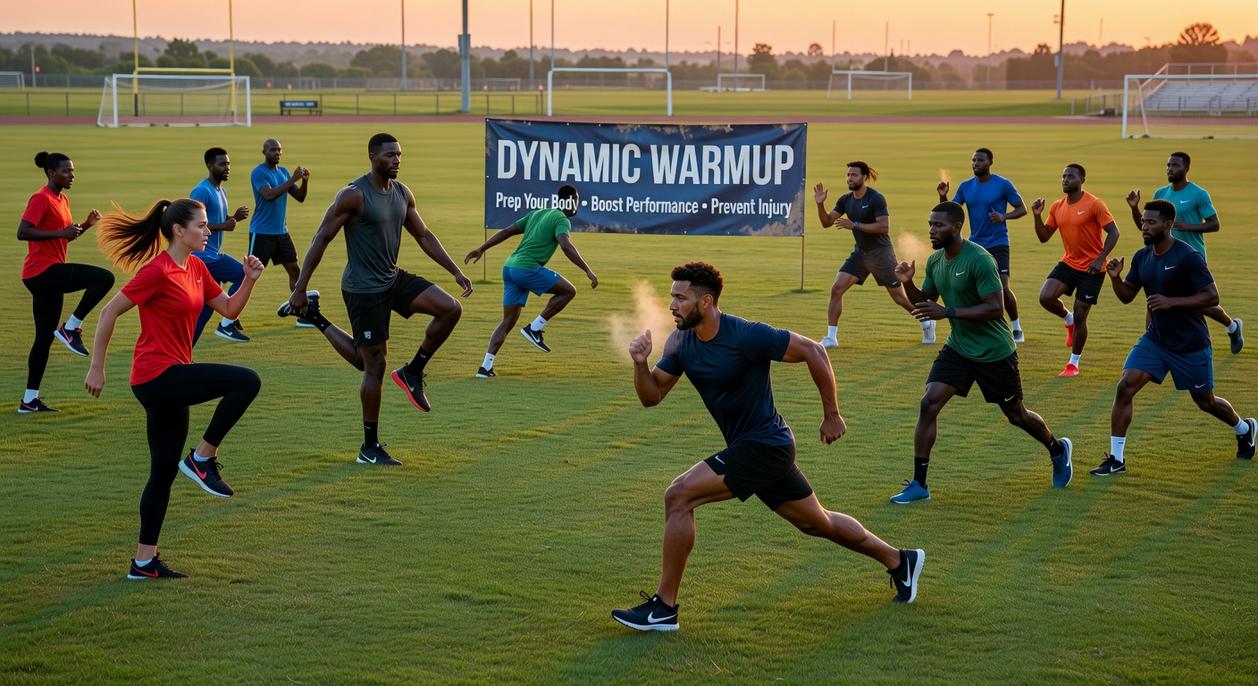
Think of this as your go-to sequence of dynamic warm-up drills you can use before hockey, lifting, running, or even a long day at your desk. Perform 10–12 repetitions or 30 seconds per movement, focusing on controlled motion rather than speed (this isn’t a race).
Lower Body Movements
1. Leg Swings (Forward & Sideways)
How: Hold a wall for balance. Swing one leg forward and back, then side to side.
Why: Opens hip flexors, hamstrings, and adductors—key for stride power and lateral cuts.
2. Walking Lunges with a Twist
How: Step into a lunge, rotate your torso toward the front leg, alternate sides.
Why: Activates glutes, quads, and core rotation (great prep for shooting or passing mechanics).
3. Bodyweight Squats
How: Feet shoulder-width apart, sit back and down, chest tall.
Why: Warms up quads, glutes, and ankles while reinforcing solid movement patterns.
4. Glute Bridges
How: On your back, feet planted, drive hips upward and squeeze.
Why: Fires up glutes to protect the lower back and improve explosive drive.
Upper Body & Core Movements
5. Cat-Cow
How: On hands and knees, alternate arching and rounding your spine.
Why: Mobilizes the spine and improves posture awareness.
6. Thoracic Spine Windmills (T-Spine Rotations)
How: Side-lying, rotate your top arm across your body and open wide.
Why: Enhances upper-back rotation for smoother stick handling and shooting.
7. Arm Circles (Forward & Backward)
How: Extend arms out and make controlled circles, switching directions.
Why: Warms shoulders and increases blood flow to stabilizing muscles.
8. Inchworms
How: Hinge forward, walk hands to a plank, then walk feet forward.
Why: Activates hamstrings, shoulders, and core in one fluid pattern.
Full Body Integration
9. World’s Greatest Stretch
How: From a lunge, drop your elbow inside your foot, then rotate upward.
Why: Targets hips, thoracic spine, and hamstrings simultaneously.
10. Bear Crawls
How: Knees hover under hips, crawl forward slowly with opposite hand and foot.
Why: Builds total-body coordination and core stability (you’ll feel this fast).
Pro tip: If you’re short on time, pick one move from each section for a balanced, efficient warm-up.
Let’s be honest: skipping your warm-up feels efficient, but it quietly costs you power, mobility, and durability. Tight hips limit stride length. Cold shoulders sap shooting strength. Worse, unprepared tissue is more prone to strains and pulls (and nobody wants to sit out because they rushed).
Instead, replace that half-hearted jog with the R.A.M.P. method—Raise, Activate, Mobilize, Potentiate. First, elevate your heart rate. Next, switch on key muscle groups. Then, move joints through full ranges. Finally, prime explosive patterns that mirror your workout. In short, prepare with purpose.
Start your next session with 10 focused minutes of dynamic warm-up drills. You’ll feel sharper edges on every sprint, lift, and cut. More importantly, you’ll step into training confident, not cautious.
So, before your very next workout, commit to this ritual. After all, a deliberate warm-up isn’t wasted time; it’s the foundation that makes strength safer, speed smoother, and progress sustainable long-term.
Take Your Game-Day Performance to the Next Level
You came here looking for a smarter way to prepare, perform, and gain an edge on the ice. Now you understand how the right structure, intensity, and focus—especially through dynamic warm-up drills—can elevate your speed, reaction time, and overall impact during the game.
Skipping proper preparation is often the hidden reason behind slow starts, missed opportunities, and preventable injuries. When your body isn’t fully activated, your skills can’t show up when they matter most.
The solution is simple: make intentional warm-ups and focused skill work part of every session. Commit to refining your movement, sharpening your stick handling, and preparing your mind before puck drop.
Thousands of serious players rely on proven training insights to stay ahead of the competition. If you’re ready to stop feeling one step behind and start dominating shifts, put these strategies into action today—and make every game your strongest yet.